
May 18, 2023
On Thursday, I volunteered with the DNR on a turtle project. I stopped at the bridge to take photos. The beavers had rebuilt a lodge next to it on the north side. Geese flew by further up the lake. Swallows made a ruckus going back and forth between their nests on the underside of the bridge and the water. I walked up onto the road and crossed, leaning on the side of the bridge. A painted turtle worshiped the sun, perched on a snag in the channel.
Time to meet Jeff. Back in the van, I continued down the road to the TNC residence. Surprisingly, I wasn’t anxious, but excited. – Turtles are just as awesome as snakes. Jeff came out of the house to meet me, “Good to see you again,” he said cheerily, hand extended.
Shaking his hand, “Good to see you too,” I replied.
“Come on into the house and we’ll get your paperwork done.”
“Okay.” He led the way.
Holding the door open for me, Jeff said, “kick your shoes off here, so you don’t track sand in.” A narrow table sat just inside the door, to the right. Indicating the opposite side of the table, “take a seat in that chair.”
I walked around the end of the table and sat down. Jeff sat opposite of me. “The two guys helping us today work for the Nature Conservancy, they aren’t ready yet. But two reasons I wanted you to come earlier, first to do the paperwork, and second to talk about your book some more and how you’re coming on it.”
“Okay, great.”
“So let’s start with the paperwork.” He pulled out several sheets of paper and held up each sheet separately, “So read over everything, front and back before you fill it out and sign your name.”
Taking several minutes, I read through and filled out the papers. After finishing, I handed the stack back to Jeff. “So your book.”

“Yeah. Well I have been working on it but progress seems very slow.” I went on to describe all the pieces I am trying to stitch together, how I am laying it out, where the geology and history will go, the challenges I have before me. I talked about my interviews with the locals and the insights I have gained through them. “I have found people like or are indifferent about the Nature Conservancy but they don’t really like the DNR.”
“Yeah, I have felt that. They don’t necessarily say anything but I definitely feel it.”
“Yes, because most of them hunt and fish, they see the DNR as the bad guy who interferes with that.”
“Yeah.” We continued the discussion further. Perhaps people misunderstand the purpose of the DNR, what it is trying to do and its limitations because it is a government agency and has limited funds. DNR employees I have met and know well love our natural resources and desire to protect it for its continuation and not just for the benefit of people.
We also discussed farmers having the view that land is unproductive if it isn’t cultivated for crops and that balance between needing farmers and preserving natural areas. Which qualifies me to write this story because I am a farmer but I am also a naturalist.
Our discussion could have lasted longer but the TNC guys were standing outside in their waders waiting for us.
“Well, I will file the paperwork quick and then we can get started.”
“Sounds good.” I slipped my shoes on and went back outside to my vehicle and pulled out my waders. I stepped out of one shoe and slid my foot into the waders, and then the other, and pulled it up the rest of the way. The boots were tight but the waders themselves were comically big – they guys wore their waders better.
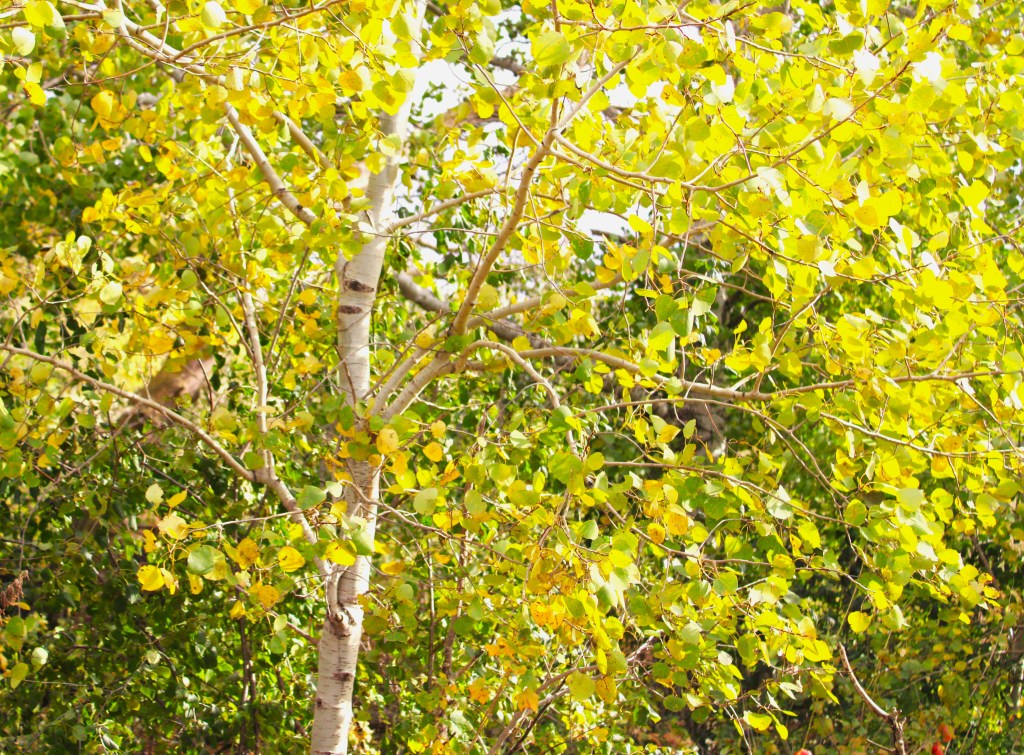
Jeff came out of the house, we loaded up our supplies and hopped into the truck. (First, Jeff showed me the traps – they use two different kinds, a crab trap (rectangular) and a hoop trap. He showed me how each were opened and how to secure them. He also explained how to re-bait the traps.) We drove down the highway to the “sand road”, stopping by the little pond with the most beautiful aspen trees I have ever seen. With three of us helping Jeff he didn’t go into the water very far. We each had a large, plastic storage bin with a string to hold on to, and a tin of sardines. The two young men had helped before, they went straight into the pond, knowing exactly where the traps were. I followed behind Jeff.
“See that stake there?” He indicated the location of the third trap.
“Yeah.”
“The trap is too far into the water. Re-stake it so it’s not as deep.” Jeff stuck a thermometer into the water.
“Okay.”
I stepped into the pond, noting the strange sensation of being in water and not getting wet but feeling its coolness, and the slight buoyancy of the waders. The bottom was mucky, sucking at my boots a little. A branch snapped underfoot and I hobbled over a large log. The water wasn’t deep, perhaps around my knees. I had a crab trap. The string of the container was looped around my elbow, the rectangular tin of sardines in my chest pocket. I struggled with the fasteners on the trap, trying not to get frustrated with myself. A Blanding’s turtle, Emydoidea blandingii, patiently waited inside. Finally, I got it open. “I’ve got a Blanding’s,” I called out.
“Okay!” Jeff replied excitedly.

I reached in to scoop up the turtle, I needed both hands. Squirming, its sharp claws scratched my hands. I gently set it into the bin and moved closer to the water’s edge, setting the bin down out of the water. I opened the clam shell fruit container, I had pulled out of the trap, dumped out the old sardines in the grass and returned to the trap. I pulled on the tab of the fresh tin but couldn’t get it open. I turned around and set it on the log and pulled, holding it down with the other hand. I got it. Dumped the sardines into the clamshell, closed it and placed it back into the trap. I fastened it shut, yanked out the stack and repositioned the trap to Jeff’s liking, picked up the empty tin and returned to land. I carried the bin with the turtle up the slight incline to the truck and the guys. The other two traps had been empty.
“Alright, let’s take a look at this turtle,” Jeff said, sitting down on the ground next to the bin with his bag, full of supplies. “This is a new turtle.” It hasn’t been marked.” He lifted the turtle out of the bin. The turtle retreated inside its shell.
“Does anyone want to take a guess at its gender?” He turned the turtle over to have a look at its plastron.
“Male, but it’s concave,” Chris answered hesitantly. I thought about it, taking in the shape of the plastron; I didn’t say it but I thought male as well because it was concave.
Jeff replied, “It is a male; since the plastron is concave.”
“Okay, why do I always get that mixed up,” Chris said. Remembering which is which can be tricky. But in this case, think about that the male has a concave plastron for ease in mounting a female to mate. His domed carapace had pale yellow flecks. Blanding’s are classified as medium to large turtles with a helmet shaped profile and yellow bars and spots. The bright yellow chin and neck is the easiest way to identify a Blanding’s. He has yellow splotches on his legs too. (Named after William Blanding, a medical doctor and naturalist from Philadelphia.) The scute across the top of his carapace appeared cracked. Jeff set him back down in the bin, he poked his head out of his shell just a little bit. (Jeff had already scanned the turtle for a pit tag, there wasn’t one.)
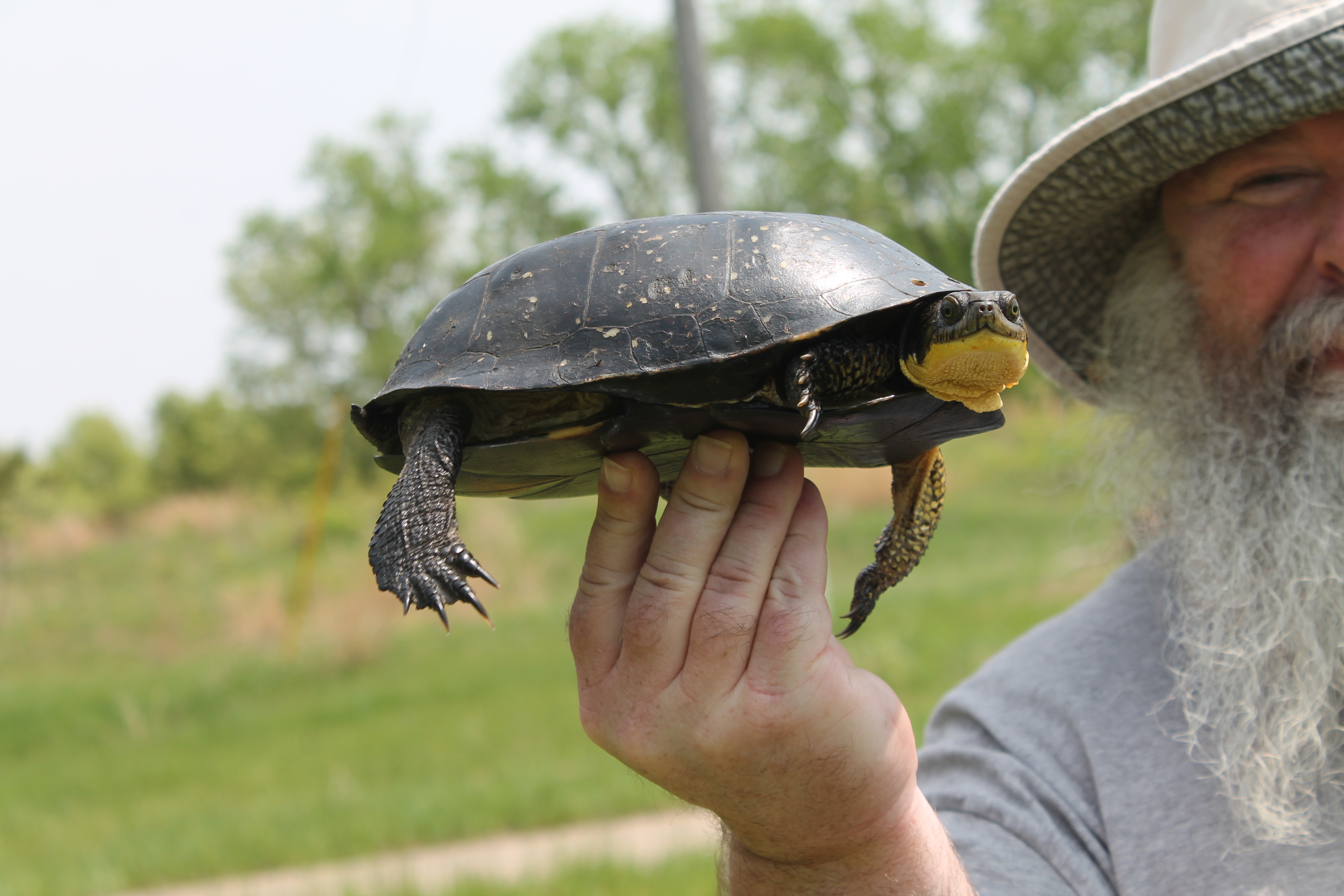
Looking at the underside of the turtle, Jeff said, “He’s old. His plastron is so worn, we won’t try to age him. I still find turtles marked by Mike Pappas back in the 1970s.” Not only was this turtle’s plastron worn but it looked chipped, like paint, in a couple of spots. Continuing to instruct, with a syringe containing the pit tag, Jeff demonstrates, tagging the turtle. “They used to mark by notching the edges but it was hard to tell if they were marks or injuries, so now we drill holes. I use a dremel.” He had a code, which scutes to mark so this individual has its own markings. After he counted the scutes, he began to drill, going slowly to feel it poke through. The dremel whined, dust drifted up. The turtle held his shell tightly shut. Jeff recorded the marking code, pit tag number, and gender – and the temperature of the water and which pond we were at.
“Okay, someone can take him back and set him down at the water’s edge.”
“I will,” I gingerly scooped up the turtle and returned him, wishing him well. The guys packed up and we headed out.
Jeff instructed, “To the next pond.” We quietly rode the short distance. I had never been to this pond before but have driven past it many times.
John handed a bin and tin of sardines to me, from the back of the truck. Chris and John led the way across the prairie to the large pond, situated between small hills. I trailed far behind them, having a much shorter stride. Jeff was behind me. This time I could easily see the stake holding the trap the guys had left for me. I stepped into the pond, again that strange sensation. The bottom of this pond was much worse about sucking my boots, I was worried I’d get stuck. Each step forward was a struggle. The water was deeper, it felt good though. John called out, “I have a snapper!” Jeff laughed a little. “But it’s a small one.” I wasn’t paying attention to how he got it out but he did and without incident.
Chris said his trap was empty. I had just looked into mine and was trying to untie it, a hoop net. “I have a good sized Blanding’s and two small painted turtles.” (Jeff records the number of other turtle species caught but doesn’t tag or mark them.) “Can I release the painted turtles?”
“Yes, you can let them go.” I took out the painted turtles one at a time, watching them disappear beneath the water. I placed the Blanding’s into the tote. I removed the bait container, opened it and threw out the old bait and refreshed it with a new tin of sardines, which I again struggled to open. I placed the bait back in the trap; grasped the end and looped the tie string around and tied it off – so it was set to catch more. With great effort, I slogged back to shore.
We gathered in a semi circle around the Blanding’s turtle, sitting in the grass. Jeff first checked to see if it had been marked and pit tagged (waving the scanner wand over it.) Another new turtle, and male. The front edge scutes had yellow stars, upper scutes had rays of pale yellow sunshine. He had withdrawn inside of his shell.
“Does anybody want to try to pit tag and mark him?” Jeff asked.
After a moment of silence. Chris spoke up, “I’ll give it a try.”
“Okay.” Jeff handed him the syringe with the pit tag and walked Chris through it. Next, Chris figured out which scutes to drill for the code and began drilling. The whine of the dremel was annoying. Dust wafted upwards. A hint of burnt smell. I was impressed he’d wanted to try it – looked intimidating. This turtle was missing a back foot.
“Let’s each count the rings, and see what we come up with for his age,” Jeff said. I believe both Chris and John counted twenty four and I had twenty.
Jeff said, “Twenty six.” Jeff wrote down the needed information. I took the turtle back to the pond and released him. We walked back up the slight incline to the truck and climbed in.
Our next stop was back at the Nature Conservancy house. Once again, Chris and John were way ahead of me and went to the furthest two traps. I plunged into the water, enjoying its coolness now, though the sensation was still strange. I had a crab trap this time, and struggled to undo the clasps. Neither one of the guys had anything.

“I have a Blanding’s with markings,” I called out. I put it in the tote and swapped out the bait and closed up the trap. I carried the tote out of the water and through the thick, tall vegetation around the pond and set it down in the mowed grass. We all gathered around.
Jeff picked up the turtle, “Female. I remember her,” he waved the scanner over her. “Hmm, no pit tag, but she’s been marked. That doesn’t make any sense.” Unlike the males, she wasn’t hiding in her shell. She kicked and wiggled as much as she could trying to get away. I was awed that each turtle looked different. Her markings were more like dots. Jeff set her down in the grass and told us to watch her. – Someone had pulled in and he was talking to the guy. I picked up the turtle. She kicked fiercely, successfully scratching me with her long, sharp claws. I wanted a look at her plastron, which was well worn. I set her down in the grass. She kept going and going. We kept cutting her off and redirecting her. She was a perfect subject for my camera. Jeff came back and we sat on the ground. He checked the turtle again for a pit tag but confirmed there was none. He figured another volunteer had tagged the turtle but was hesitant so didn’t get it stuck in very well and it fell out. While he was examining her, plastron up, she stuck out her neck all the way and moved her head side to side and back and forth – it was fascinating and a bit freaky at the same time. Chris thought it was strange too. Jeff put a new tag in her and recorded the necessary information. John returned her to the pond; I followed to take a photo of her disappearing.
I thought perhaps we were done; but there were two more ponds to check. We parked alongside the road for the next one. The truck leaned so much I could barely keep the door open long enough to hop out. Chris saw and held the door open for me. I thanked him. There were only two traps at this pond, so John and I checked them. (It was a bit of a trek to this pond, tucked in the dunes, and invisible from the road.) John’s was empty. I once again had a Blanding’s. I put him in the bin and gave it to Chris while I switched out the bait and reset the trap. He had three yellow dots on his scute by his head. Again, I marveled at how different his markings were from the others. He had not been marked. Jeff asked if any of us wanted to mark and tag him but we passed. I wanted to do the tag but was too nervous and didn’t want to mess it up – also I am not sure I could have held the turtle well enough with one hand. He pulled into his shell immediately. (Jeff takes before and after pictures of each turtle.) This turtle’s plastron had a lot of color, a molten river of lava down the middle and branching off. We each took turns counting the annual rings. John counted eighteen, Chris and I both counted twenty two. Jeff counted twenty four. Chris returned the turtle to the pond. We packed up and returned to the truck.
Our last pond was down the road in the other direction, accessed by a narrow driveway. A barbed wire fence crossed the path to the pond. Chris and John had no trouble stepping over it. I had to go under. Again, the guys took the further traps. They both had nothing. I had a medium size snapping turtle in mine. It was quite the process to get it out without coming in contact with its mouth. Jeff was good naturedly laughing at my effort. But I did free it and replaced the bait. Jeff was amazed we had caught Blanding’s at all the other ponds and not this one – that was very unusual; this pond was where they usually got the most.

Back at the TNC building site, we had a bullsnake to process. The guys found it yesterday while making a firebreak on the prairie. Jeff gingerly removed it from the bag. “It’s a female.” She was restless and nearly went off the table several times. Jeff scanned her for a pit tag and found none. He asked me, “Do you want to try and measure her? Its fine if you don’t want to.”
“I’ll give it a try.” She wouldn’t stop moving and I struggled to keep the tape measure in place long enough to read.
“That’s ok, I can do it,” Jeff said taking over. He expertly did so. Next, he had me weigh her which was much easier.
“Wow, she’s hefty,” I said.
“That’s because she’s gravid.”
“What does that mean?” one of the guys asked.
“She’s carrying eggs,” Jeff replied.
“Cool,” I said, awed.
“Now to pit tag her, I distract the head.” He had her crawl into the bag of supplies.
“Then it makes it easy because she’s pulling away, making it taunt.” He inserted the pit tag; making it look so easy. It was thrilling to hold a snake again. She was fairly laid back for a bullsnake. Once Jeff said she was carrying eggs, I could tell she was swollen but not from eating. As we were going to leave the shop to release her, it began to rain, not bad at first but then it came harder. Jeff pulled up a chair for himself and me. We watched the clouds. The guys busied themselves with preparations to burn. A couple of times we thought the rain was done but it began again. Finally it stopped and the sun came out. John led the way to where he’d found the snake. The hike was difficult in the sand and over branches and logs they had cut down. It was about a ten minute walk. Jeff took some photos of her and a GPS reading. Then John let her go. We watched her disappear. That concluded my day of volunteering. After making plans for my next visit, I headed home.
View more photos at https://www.instagram.com/bethanybenike


 In Pursuit of Wonder
Leave a comment