

October 20, 2024
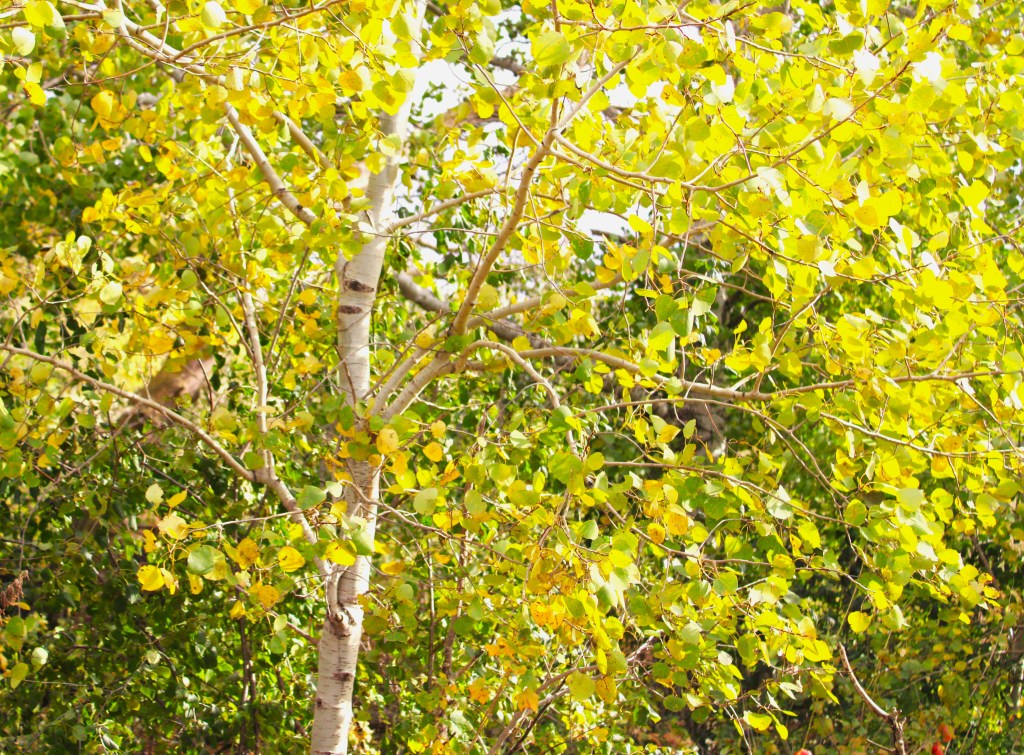
Autumn leaves scintillated in the afternoon light, setting Frontenac State Park ablaze. Maples, oaks, aspen dazzled in various hues of yellow, orange and red. Trees swayed in the breeze. Overwhelmed by the beauty of the colors, I pondered if it were possible to capture it either in words or photos. Jesse led the way down the paved path, weaving through the trees. This time we started our hike of the Bluff Trail at the opposite end from where we have in the past. As we began to descend the bluff, I paused to capture golden maple leaves illuminated in the sweet October light. At first, wooden steps took us down the bluff a ways. We halted below a rock face, taking in the size and grandeur of the cliff. Already, the sunlight was beginning to fade as the bluff blocked it. I was somewhat surprised that the further down we trodded, the more trees were still dressed in summer green. Jess continued to lead the way down a switchback, dirt path. We caught glimpses of Lake Pepin through the treetops, a shimmer of dull blue. Frontenac State Park, especially in October, is an impressionist painting come to life – every few steps found me taking pictures. (Sadly, probably most of them will sit on my computer unseen and therefore unenjoyed. I need to figure out a way to market my photos so they can bring joy to many people, not just me.)
A wooden bench marks the intersection of trails. One leads to a former quarry, we have yet to explore that direction. Jesse continued to lead us down the Bluff Trail, after pausing for me to catch up to him. I had been taking in the rock wall, in addition to taking photos. We passed sawn logs, park workers had cut to clear the trail of fallen trees. And then we ambled down rickety wooden, curving steps, cutting a path alongside maples. Boulders of various sizes perch here and there throughout the bluffside forest, adding beauty and a sense of the mythic to the atmosphere. Mosses colonizes most of them. This is a healing forest, my spirit soars here – other than when I think about the daunting, unavoidable climb back up the bluff.
Forests like this one should be protected, allowed to live its life as it sees fit, with only minimal and thoughtful use from humans, for its own sake. Hardwood deciduous temperate forests are a wealth of life, especially when there is a balance of old growth and new growth. Much more is going on in these forests than just trees and far more than what we can observe with the naked eye. Complex inter and intra species relationships occur – beautiful interactions of mutual aid. Even the parasitic relationships are crucial to a healthy ecosystem, in the cycling of nutrients. I marvel at these interactions I can’t not see and many I don’t understand or am not unaware of, and at the ability for nature to heal itself and its desire for balance. It is a humbling thought that if all humans disappeared from the planet, almost all other life would thrive, and perhaps be better off without us. Humans need to learn more and more about nature, to develop a deep respect and reverence for it. And we must learn from nature – the answers to our current climate crisis can be found in the trees and grasses. We can coexist without ravaging the earth’s resources. I am frustrated and angered that we have the technology and knowledge to stop the climate crisis and even bring the global average temperature back down the necessary four degrees fahrenheit within perhaps thirty years. The right people, and all people need to take action – a simple but politically difficult solution would be to remove thirty percent of all the world’s corn and soybean fields from production and return that land to permit, natural for that local area, vegetation. I hope that Jesse and I can do even more of this on our farm and demonstrate how it can be done while still allowing farmers to make a living. Jesse tells me it will never happen, people don’t change. But I would like to think people can be educated and even the most selfish billionaires can be persuaded to do the right thing even if it is to expiate their guilt. (All people no matter race, ethnicity, nationality, religion, creed, politics, gender or sexual preference, should care about the environment because this is the only home we have.)
Trees are often overlooked and underappreciated creatures that may be more sentient than we know. I paused to revel in the gnarled roots of a tree growing along the path, marveling at how much greater the root mass is beneath the surface, holding the soil tightly in its grasp, doing its part to keep it from washing into the Mississippi River. The trail took us horizontally across the bluff for a while. At yet another wooden bench, is a choice to keep going along parallel to the hill or plunge further down, eventually reaching the water’s edge. Jesse led the way downhill, desiring to reach Lake Pepin. I progressed slowly, looking up at the underside of the canopy, and down at the characterful reaching of tree roots. The trail continued to wind, switching back along the hill. I noted a patch of wild ginger, and paused to take in a log returning to soil. A flight of steep, wooden stairs led down to the lakeshore, large pebbles rather than sand. We sat on a fallen tree letting the sound of the waves wash over us and soothe our weary souls. A family also enjoyed the lakeshore, but once they moved on, we sat upon large rocks closer to the water.
We are quite wealthy, to be able to visit the only natural lake on the Mississippi River in only a forty minute drive from home. Lake Pepin is a marvel. Jesse said it’s crazy that Wisconsin is just over on the other side. We observed gulls following boats. Boats fascinate and sadden us; like everything, boats have gotten bigger and bigger, and their wave action has also increased, eroding the riverbank, choking the river with sediment and destroying habitat. Motorboats are like cars, you can’t fully enjoy the natural world around you whilst in (or on) them because you are removed from it encased in noise and speed. Motorboats also decrease the surface size of the body of water by crowding it, reducing its wonder. Try a canoe or kayak instead; they are quiet and allow you to be close to nature and feel good about moving forward by your own physical effort.
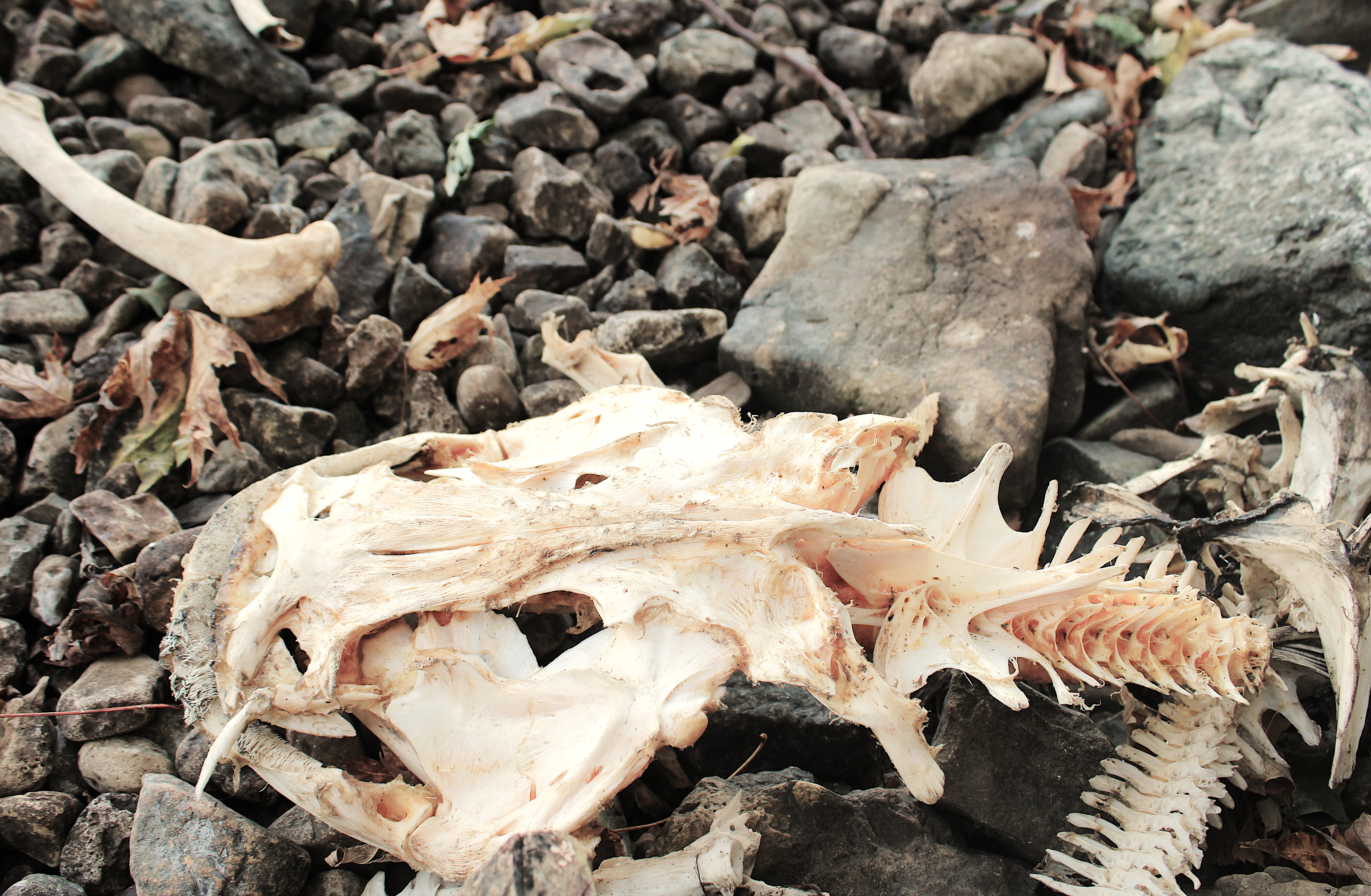
All sorts of debris has washed up on the pebbly beach; driftwood, trash, a piece of rope from either a barge or towboat, pieces of shells, and fish bones. A few bones were not from fish, perhaps deer bones. The girth of the rope was interesting, but the bones were what held my attention. I had not seen fish skeletons before, and found them fascinating. They look cartoonish; a two-sided comb. A large skull intrigued me the most. It appeared alien. The vertebrae remaining were large. The mouth had a couple of finger sized projections, called barbels, and little hair-like projections coated the jaw bones. This was a catfish skull. Incredible. I wish I had brought my backpack, I wanted to bring it home with me to add to my collection; I have nothing like this. But it was too cumbersome to take back up the bluff without some sort of bag to put it in – Jesse was unwilling to carry it for me. The bones were textured with small lines. The pungent smell of fish oil permeated them. Flat, wide bones also caught my attention – perhaps fin bones? The more complete skeletons were the average fish size. But there was another skull attached to a few vertebrae, considerably smaller than a catfish but quite a bit larger than the other fish bones. It had a tooth-like projection, barbel. I am unfamiliar with fish, but this may have been a burbot (eelpout). The bones were somewhat in a pile, and a feather lay nearby. Jesse and I wondered if they washed up like that or if a scavenger (human, bird, or mammal) arranged them. Jaw bones and vertebrae sat unattached, I picked up these to have a closer look. They felt nearly weightless. (I kept one jawbone and vertebrae to take home.) Jesse was more interested in the water and the flying gulls than the fish bones. He desired to walk across Lake Pepin when (if) it froze solid in the winter.
After we had lingered for quite awhile, we decided it was time to keep moving. Jesse led the way up the wooden steps. After a bit of a climb, we rejoin the Lower Bluff Trail, which takes us across the bluff side for a while rather than up. Negotiating around boulders and fallen trees, I pause often to take pictures of the beautiful landscape. Several times, I ran to catch up to Jesse. – If he stopped it was only to wait for me. The lime green canopy of the maple trees not yet in fall color was enchanting. I desired to linger and climb on the fallen trees and boulders, but I resisted the urge and continued trekking, looking up into the canopy and down, glimpsing the lake between the trees. I marveled in a thick patch of wild ginger. I took in the birdsong, but failed to pick out individual species other than bluejays. We turned a little to the left and were greeted by stone steps leading up the bluff. Unfortunately, no matter where you begin, while hiking the Bluff Trail it becomes necessary to climb back up the bluff. It is a beautiful and invigorating hike but rather challenging. My lungs burned as I struggled to breathe, but I knew the climb was good for me. Despite the challenge, I relish the layout of the trail, stone steps, tangle of tree roots. Before ambling up the wooden steps, the last leg of the climb, I pause to photograph the rock formation with the hole straight through, struggling to get a good angle on the rock around other people and the switch-back of the trail. One final, breathless climb, and we are back near the top of the bluff. Jesse led the way to the overlook to check out the top of the rock formation and the tree framed view of the lake. We observed a cardinal hopping about on the rock below us. And chatted briefly with an older couple. Onward, we scrambled up more wooden steps but this time the rise was more gradual and therefore less challenging.
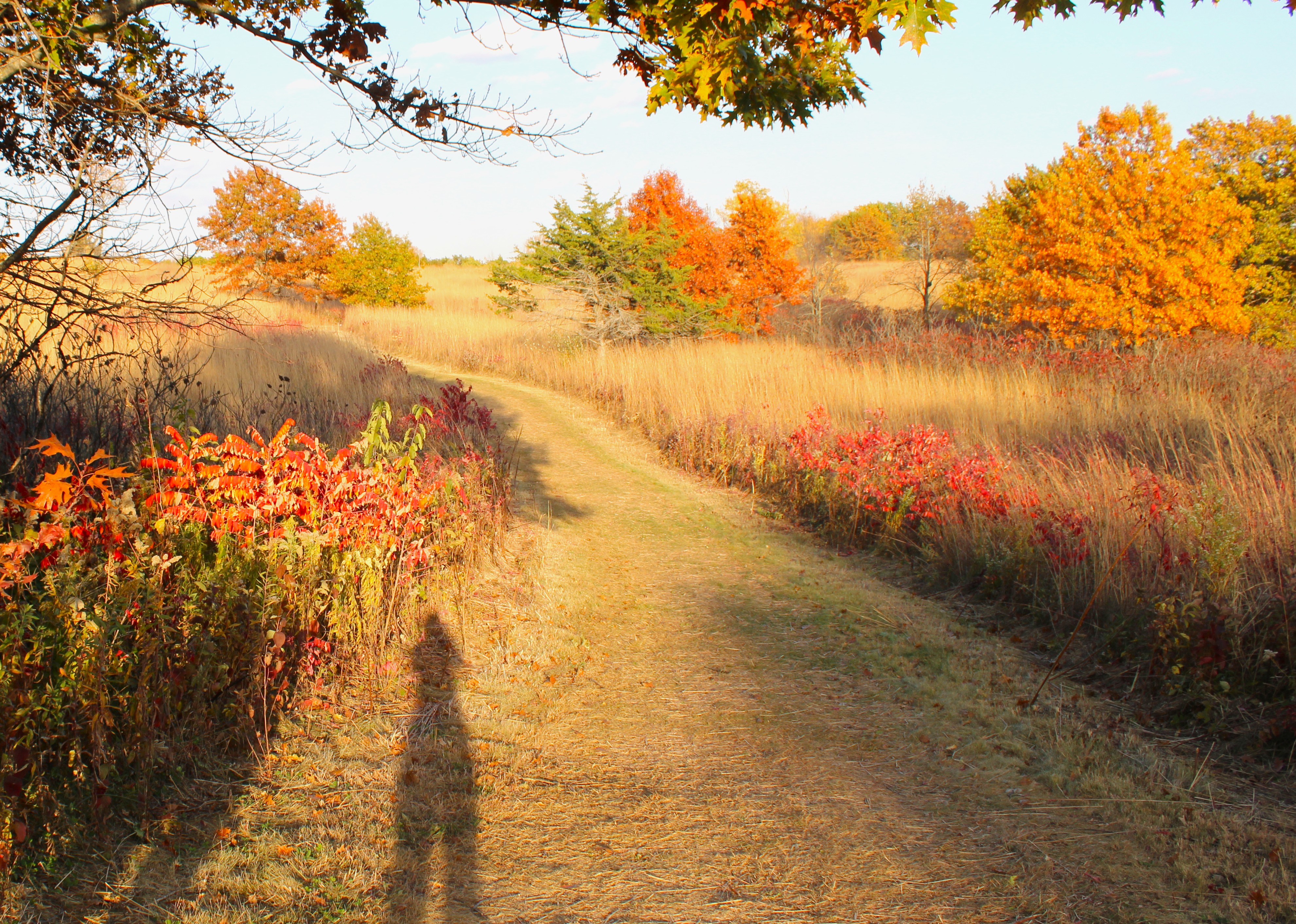
At the top of the bluff, rather than heading left to go along the top back toward where we had parked, Jess, wanting to explore more, led the way toward the campgrounds. We met up with a trail that seemed to skirt around the campsites and took us to the prairie trail. Usually we only do the bluff trail, so it was fun to explore new-to-us-territory. We stepped out from red orange maples and scraggly sumac. The bluff top shone gold in the late autumn sunlight. The path wide and grassy wove along through brushy trees, with a few larger maple trees. Unlike the maples on the bluff side, these were in full pumpkin array. We passed by oaks transitioning from summer to autumn color, leaves a green orange. The scraggly pattern of sumac branches reminded me of a storybook. A few oak trees were clad in russet leaves. A garter snake slithered across our path, disappearing before I could attempt to photograph it. Yellow poplar leaves tinkled in the gentle breeze. We paused to study a bird’s nest built on a sumac, but had no idea what kind of bird it belonged to. I relished the fuzzy seed heads of goldenrod and the amber stems of bluestem grass. I marveled at the deep red of the few remaining sumac leaves.
The winding trail took us to the highway, we crossed it to continue our prairie walk. We paused briefly to look at a log lean-to, a modest shelter for hikers. The prairie trail became more tree-lined, and thick with goldenrod. I marveled at characterful oak trees. Jesse pointed out another garter snake, nearly hidden, resting beneath a bush. At the beginning the prairie trail had moved away from the bluff edge, but it had meandered back to it. The trees opened up to a panorama of Lake Pepin and the Wisconsin bluffs. We observed a barge progressing downriver. We glimpsed an old, beautiful barn through the trees below us. We lingered for a while, taking it all in. We exchanged a kiss before moving onward. I continued to marvel in the reds, oranges, and yellows of the trees and non-woody plants, falling behind Jesse many times. We emerged from the fiery, autumn clad trees, again walking along bluestem grass. The trail had wound back to the parking area. Frontenac really shines in the autumn.
Visit https://www.instagram.com/bethanybenike/ for more photos
Purchase a copy of each of my books on Amazon – Dandelions https://a.co/d/96sAFHU, Raking Leaves https://a.co/d/fnbusTI, Making Applesauce https://a.co/d/bVbQ7Hw, and Pruning Apple Trees https://a.co/d/3qUIcoV

 In Pursuit of Wonder
Leave a comment