
October 30, 2022
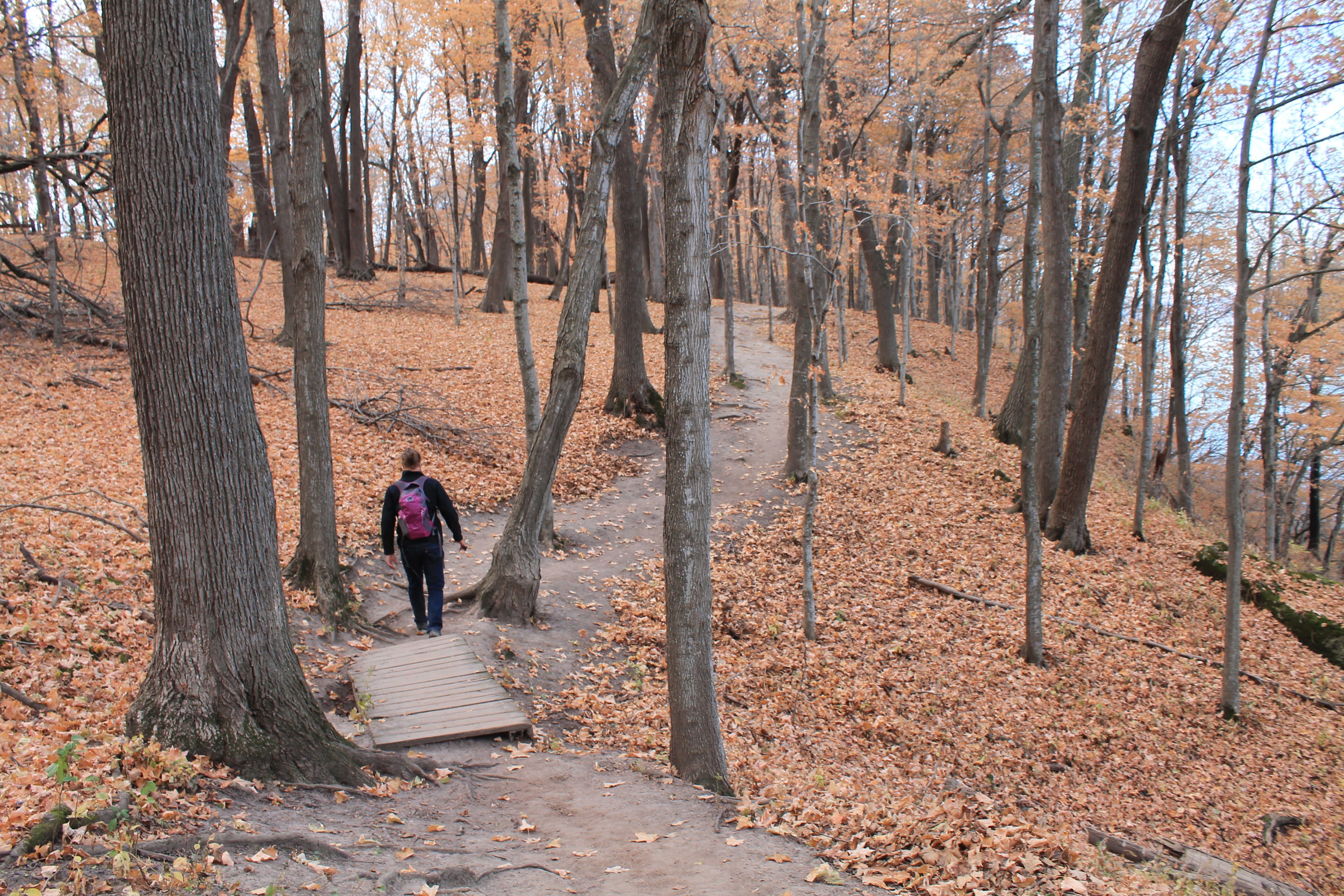
Small, quiet tinkling fills the air as the river licks gently the foot of the bluff. Gulls cry out, transporting us to the sea. The sound of tissue paper being crinkled drifts down the bluffside as frantic gray squirrels rustle and dig in the leaf litter, sometimes chattering. Except for the hideous vehicle noises drifting over the river from Wisconsin, it is calm and quiet. What are the gulls saying? A leaf silently floated down off a tree. Maples light the bluffside, golden, a blaze like sunshine. I became lost, watching a gray squirrel flit about. A bluejay cackles somewhere above. The hike down was beautiful and invigorating; the hike back up will be arduous and exhausting. A gull flew low, dipping its feet into the water, perhaps snatching something. A few more leaves float down and crash to the ground. Frontenac is a lovely place. The path is at first a winding paved trail, with some ups and downs, going with ease across the top of the bluff. For a moment it rains maple leaves. While almost too hot on the hike, I am beginning to get too cold.
Lake Pepin is a naturally occurring lake on the Mississippi River, sandwiched between Minnesota and Wisconsin. It rests in a valley sculpted by the outflow of the enormous glacial Lake Agassiz, via glacial River Warren, at the end of the last glaciation. The glacier’s meltwaters found other outlets to the sea, and the smaller Upper Mississippi succeeded the River Warren. Over time, this deep valley was partially filled with sediments, forming a broad floodplain. Lake Pepin formed in this plain behind a delta containing sediments deposited into the ancient lake bed by the Chippewa River near the present town of Wabasha at the southern end of the lake. The lake reached as far north as the present location of Saint Paul, but in the last 10,000 years, ongoing sedimentation into Lake Pepin has caused its upper end to migrate downstream fifty miles to its present location east of Red Wing, Minnesota. Sedimentation is continuing and at an accelerated rate, threatening natural flora. Lake Pepin provides fishing, swimming and boat tours. The state park is named after the town Old Frontenac, named for Louis de Buade de Frontenac, the governor of New France in the late 1600s. It was established as a park in 1957 and is 2,300 acres. (Just some more fun bit of history: “Being only six miles from Lake Pepin, one of the finest bodies of water in the West, surrounded by some of the most magnificent scenery to be found anywhere on the continent, Red Wing will probably in a short time become a summer resort… For several days we had been cautioned to “beware of Lake Pepin,” and when at last we found ourselves gliding smoothly over its placid bosom, we felt that its turbulent propensities had been greatly exaggerated. It took but a few moments however to reverse the scene and convince us that the Fates were not altogether favorable…Frontenac is a small hamlet, of perhaps two hundred souls, standing on the western shore of the lake, about ten miles below Red Wing. It is a most romantic spot in appearance, and will, I venture to predict, at no distant day become a most delightful summer resort.” – Down the Great River; Embracing An Account of the Discovery of the True Source of the Mississippi by Captain Willard Glazier, 1887.)
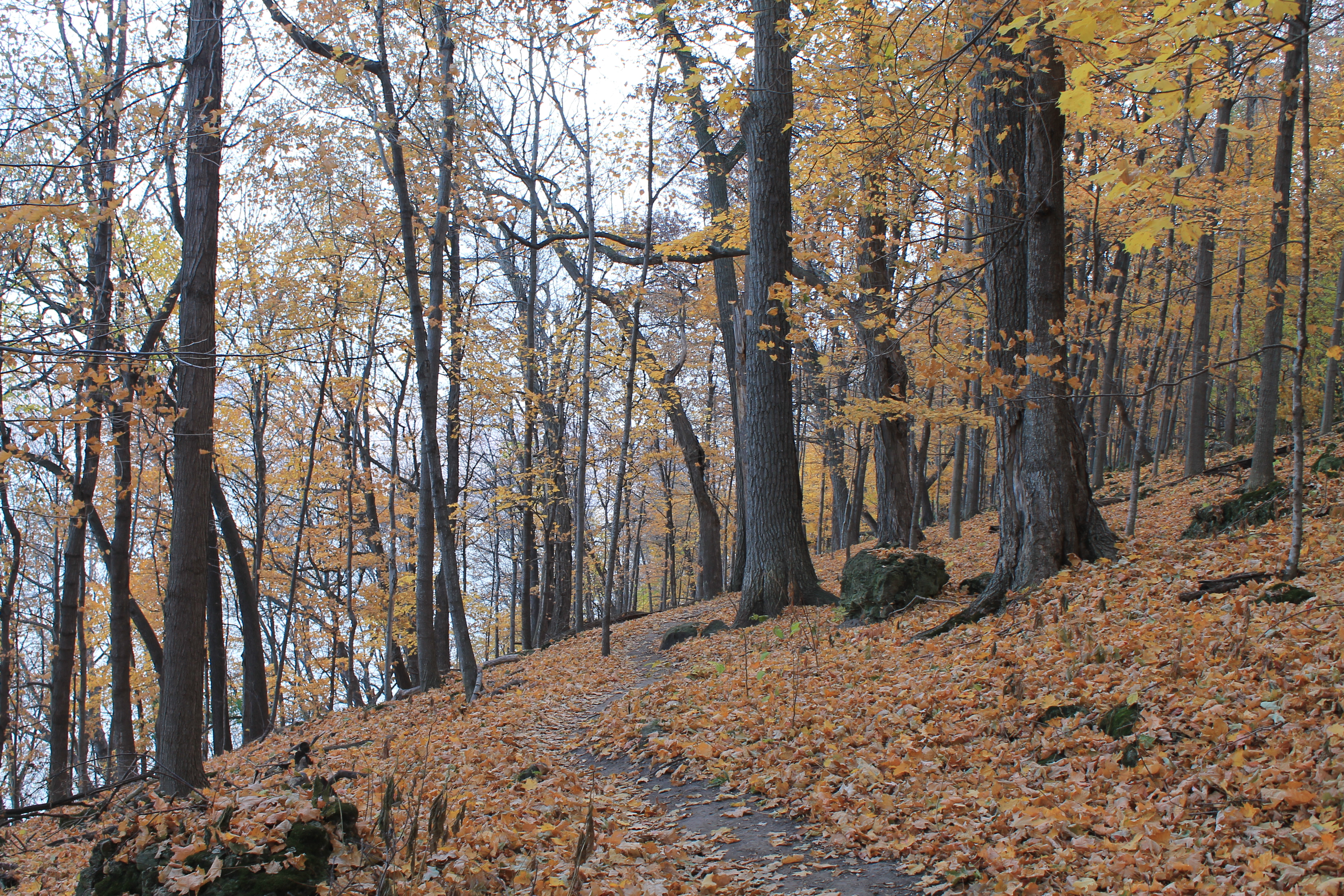
We walked across the top of the bluff on an asphalt trail, under a canopy of tree branches. The forest is golden. Leaves litter the path. The elegant beauty of paper birches takes my breath away. We could glimpse Lake Pepin down below us, through the trees. Frontenac State Park abuts Lake Pepin, encompassing bluffland, prairie, floodplain forest, and upland hardwood forest. With such diverse habitat, including the river, the park has recorded 260 species of birds. The bluff provides spectacular views of the lake. I have only been to Frontenac twice, both times in the autumn and it’s stunning. It is open under the trees. Both the ground and remaining canopy is aflame. Maples appeared to be the most numerous trees. We left the asphalt behind for a dirt trail, but it was still wide and easy. Jesse led the way and I often had to nearly run to catch up to him; I am much slower anyway but my camera slowed me down more. (I had to refrain from taking too many photos.) And there were a couple of trees I stopped to touch. I can’t describe how beautiful it was nor how it made my heart soar. Several places along the edge of the bluff stood rock outcroppings. Minnesota was covered by shallow seas, hundreds of millions of years ago. Sediment and lime deposits from organisms accumulated at the bottom of the seas and slowly hardened into rock, which now makes up these bluffs. Fallen trees lie here and there. Several places there were teepees made of fallen branches, which made me smile – my brothers and I built similar structures and spent many hours in blissful play in and around them. The sunlight illuminated the top of the bluff perfectly. A wooden staircase leads further up the bluff to campsites.
We turned to our right onto an observation deck with a view of the water but also In-Yan-Teopa, a giant rock on the edge of the bluff, which is viewed as a sacred site by some Native Americans. I told Jess that I really want to sit on top of it but climbing the rock is prohibited. There’s a hole going straight through it but we couldn’t see it very well from this angle. We became distracted by large, white birds in the water far below. At first, we thought they were gulls but they were much too big to be gulls. Also, there were gulls around them. Looking through my 300 mm lens, we saw that they were pelicans. I was thrilled; I think they are fascinating.
We continued onward, Jesse at a much faster pace than me, the trail beginning to take us down the bluff. Jesse was a bit below me. Now, I could see the hole in In-Yan-Teopa; it looked like a doorway – would it take me to Narnia? We heard something clatter on the bluff above us, on the other side of the trail, rocks skipped downhill. What had knocked rocks down? (Jesse being dramatic and not at all serious, thought it was a landslide.) I put the 300mm lens back on the camera and scanned the side of the bluff. A white-tailed deer, a doe. She was facing away – I waited to see if she would turn and she did just a very little. Such elegant and beautiful creatures. I marveled at her spindly legs that somehow are full of grace. I was awed by the grand scale of the bluff. The way down becomes steep quickly, even going down is challenging. Jesse commented that the further down we go, the more we have to go back up. We passed piles of moss covered rocks of various sizes. The path down became narrow. The trail wound its way down the hill. I loved the appearance of the slabs of stones making steps – lent a fairytale feel. Maidenhair ferns grew among the scree. Then we went down a steep, wooden staircase. The trail took us along, no longer down the bluff. I looked back up, we’d come down so far and were still aways from the bottom and the water. Dirt path, as it leveled out, then stone steps again, and back to dirt path – rocks here and there, sometimes causing me to stumble. Wonderstruck, I delighted in the trees and rocks. An oak tree’s orange leaves caught my notice. Jesse was out of sight. I could see the blue of the water through the trees. The deep, dark green of the moss contrasted brilliantly with the golden leaves. Jesse came into view again, waiting on a bench for me. The maples seemed to be marching down the bluff, or were they coming up? Jesse turned left, taking us down again. Another set of wooden stairs, not quite as steep as the last. Several more feet and down a steep staircase. We arrived on the shore of Lake Pepin. Boulders were scattered about. Jesse sat on a log to read. I tried to write. One boulder was riddled with holes, like a sponge. (Wish i knew how that happened.)
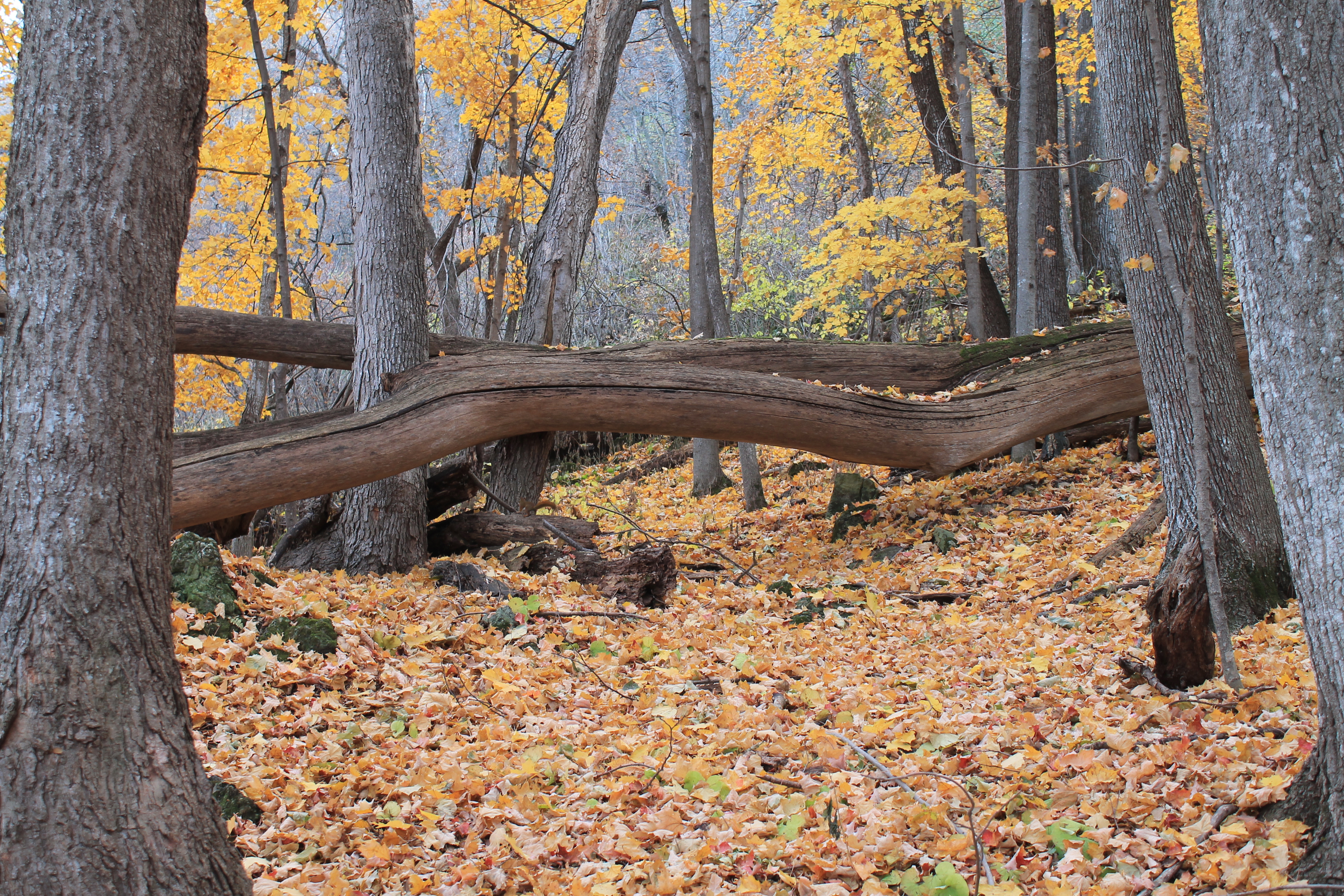
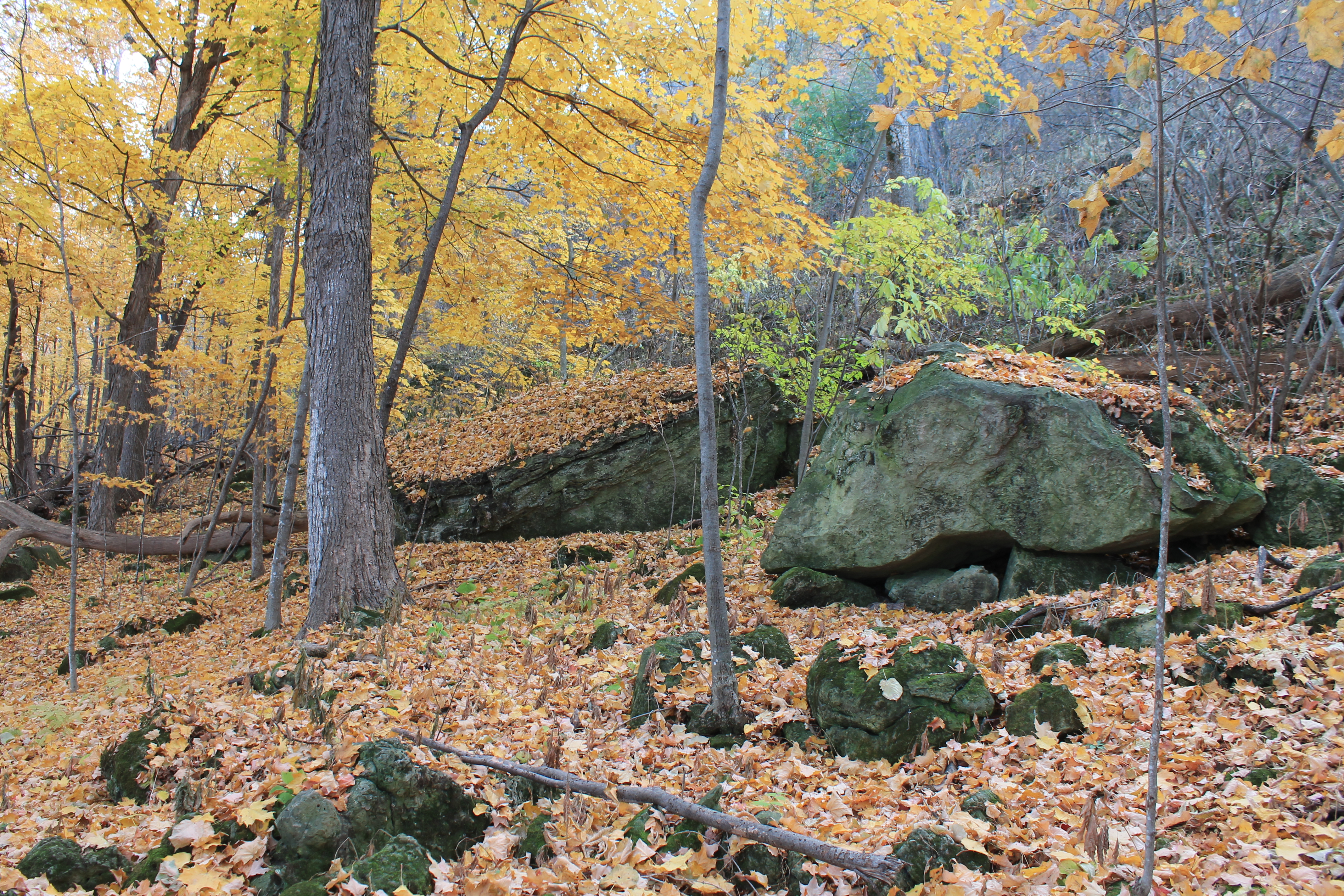
After perhaps a half hour rest along the water’s edge, we were ready to keep moving. We had to go all the way back up the bluff. Back up the first set of steps, then dirt and rock trail, the second set of steps. I paused often to photograph moss encased boulders, surrounded by various hues of gold, yellow, and brown leaves. I was already winded and we still had three quarters of the bluff to climb. We were back on the “Lower Bluff Trail”, continuing where we left off. I marveled at the huge boulders, and wondered about the tremendous amount of scree – what had it looked like when these rocks rolled down the bluff? Was it a landslide? Did they come down individually or together? I always want to know the whole geological story that I am seeing. When did these rocks migrate downhill? One boulder appeared to have been stopped by a maple tree – which was here first? The tree doesn’t seem very old. The trail wasn’t climbing the bluff but going parallel to it – easy going aside from rocks and roots attempting to trip you up. The beauty was soul lifting. Rocks and trees are my thing and this park has them in spades. Jesse was disappearing far ahead of me, again. He paused by a particularly large boulder, taller than him by a few feet, waiting for me to catch up. We could still see Lake Pepin, blueness between the trees on our left. The curvature, sinuousness of a fallen tree, over the path, being held up by another, appealed to me. This forest is inspiring. A large boulder rests upon three small boulders, like someone is trying to move it.
We came upon steep, winding stairs, and easy hiking was over as we began the ascent up the bluff. I always feel so out of shape as I become breathless almost immediately. A sheer rock wall greets us at the top of the steps. Another trail intersects this one – there’s a bench, a respite before climbing again. Either this was a former quarry or the other trail leads to it. Long before it became a park, a stone quarry operated within the park boundaries. It produced high quality limestone, a popular building material. George L. Heins and John LaFarge chose limestone from here to construct part of the Cathedral of St. John the Divine in New York City, in 1883. I would have liked to rest a few moments but Jesse wanted to keep going so onward and upward. More steps wound their way around the rock wall. Jesse asked several times if I was coming and still alive. Yes. But I paused a couple of times to look at the bluff below and how far we’d come and take in the grade.
One of my favorite things is finding a bit of poetry along a landscape I hold so dear. –
“I am the heat of your hearth on the cold winter nights,
the friendly shade screening you from the summer sun,
and my fruits are refreshing draughts quenching your thirst
as you journey on.
I am the beam that holds your house,
the board of your table,
the bed on which you lie,
and the timber that builds your boat.
I am the handle of your hoe,
the door of your homestead,
the wood of your cradle,
and the shell of your coffin.
I am the bread of kindness and the flower of beauty.
‘Ye, who pass by, listen to my prayer: Harm me not.”
– “A Portuguese Prayer of the Woods”
I wish I could write poetry, and such thought provoking ideas – something to contemplate. The top of the bluff was now in sight; almost there. We stepped out of the forest. Walking to our left, we stopped in a grassy area with a glorious view of Lake Pepin and the Wisconsin bluffs on the other side; the cliff face of Maiden Rock… “The wildness of the scenery is such that even the voyager who has gazed with delight upon the majestic bluffs of the Mississippi is forcibly impressed with the grandeur of this spot.” – Down the Great River; Embracing An Account of the Discovery of the True Source of the Mississippi by Captain Willard Glazier. Of course there is the tragic Native American legend of a young woman named Winona jumping to her death from those rocks, because she wasn’t allowed to be with the man she loved. Hence the name Maiden Rock. (The full tale is much too long to relate here.) Jesse sat on a bench reading. I lay in the grass, eyes closed, resting and listening to the birds sing.


Leave a comment